This post contains affiliate links. If you book through them, I may earn a small commission at no extra cost to you. Local buses, day baths and restaurants mentioned here are paid on the spot, with no affiliate link.
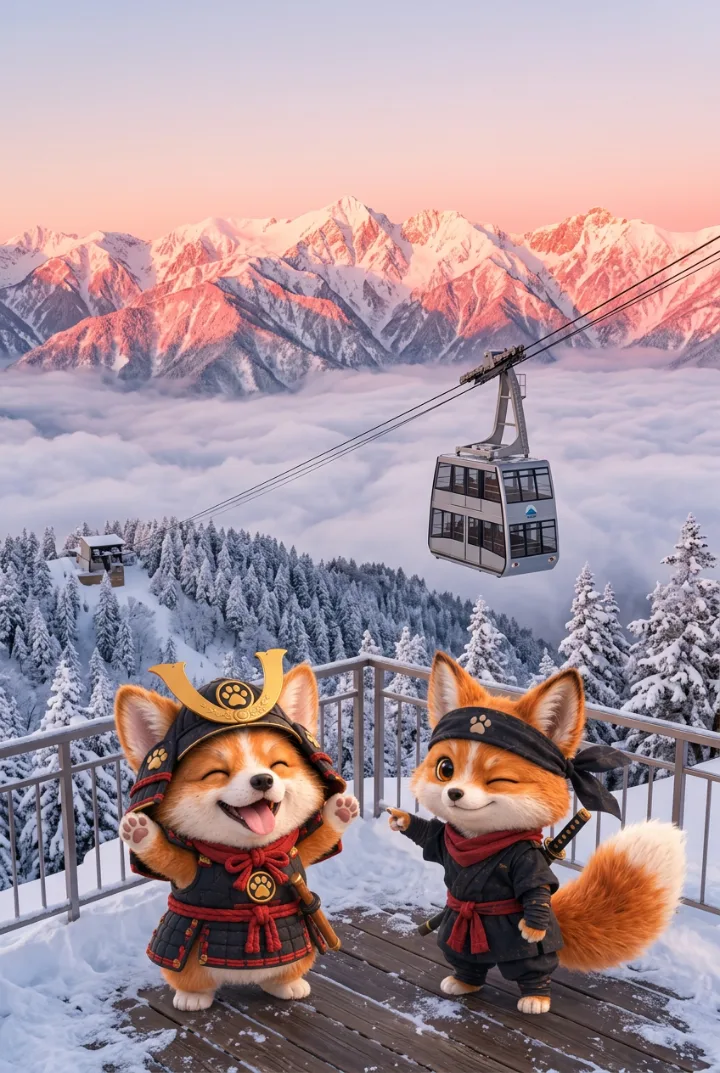
Kojiro the corgi samurai had one wish for his day out from Takayama: ride a gondola above the clouds, then sit in a hot spring until his paws went pink. Hayate the fox ninja found both on the same bus line. The Shinhotaka Ropeway (also written Shin-Hotaka) climbs to 2,156 meters in the Northern Japan Alps, and the bus there runs through Okuhida Onsen, a valley of hot spring villages.
I was born and raised in Takayama, and this is the mountain day trip I suggest to friends who already saw the old town. This guide covers the bus from Takayama step by step, the ropeway ticket price and seasonal hours, whether the Okuhida bus pass is worth it, the best day-trip hot springs, a sample itinerary, and what to know about the Shinhotaka Ropeway in winter.

Table of contents
- Shinhotaka Ropeway and Okuhida Onsen at a glance
- What is Okuhida Onsen (Okuhida Onsengo)?
- How to get to Shinhotaka Ropeway from Takayama by bus
- Okuhida bus pass or single tickets: which is cheaper?
- Shinhotaka Ropeway hours, ticket price and timetable
- What to see at the top (Nishihotakaguchi Station)
- Okuhida Onsen day trip: hot springs you can visit without staying
- Shinhotaka Ropeway day trip from Takayama: sample itinerary
- Shinhotaka Ropeway in winter: weather, snow and what to wear
- Okuhida Onsen ryokan: where to stay overnight
- What travelers say about the Shinhotaka Ropeway
- Shinhotaka Ropeway and Okuhida Onsen FAQ
- More Takayama and Shirakawa-go guides
Quick picks
- Easiest way to do it: the Okuhida bus pass from Takayama with a Shinhotaka Ropeway ticket included, so you buy one voucher for everything. Check prices for the Okuhida bus pass with Shinhotaka Ropeway on Klook (4.8/5 from 685 Klook reviews; free cancellation shown on Klook).
- Driving or already have bus tickets? Just pre-buy the ropeway: Check dates for the Shin-Hotaka Ropeway round-trip ticket on Klook (4.6/5 from 114 Klook reviews). You still swap the voucher for a paper ticket at the counter.
- Want to sleep in a hot spring village? Stay one night in Hirayu Onsen, the bus hub of Okuhida: Check dates for Tabist Kazeyuki in Hirayu Onsen on Klook (4.5/5 from 112 Klook reviews).
Shinhotaka Ropeway and Okuhida Onsen at a glance
| Quick answer | |
|---|---|
| Where | Okuhida Onsen (Okuhida Onsengo), Takayama City, Gifu, in the Northern Japan Alps |
| From Takayama | Nohi Bus from Takayama Nohi Bus Center (next to JR Takayama Station): about 1 hour to Hirayu Onsen, about 1 hour 35 minutes to Shinhotaka Ropeway |
| Bus fare | ¥1,600 to Hirayu Onsen, ¥2,200 to Shinhotaka Ropeway (adult, one way) |
| Ropeway ticket | ¥3,800 round trip to the top, ¥2,400 one way (adult); elementary school children half price |
| Ropeway hours | April 1 – November 30: first car up 8:30 (8:00 in August and on October weekends and holidays), last car up 16:00. December 1 – March 31: 9:00 to 15:30 |
| Top station | Nishihotakaguchi Station, 2,156 m, rooftop observation deck |
| Time needed | A full day from Takayama (about 3 hours on buses in total) |
| Day-trip hot spring | Hirayu no Mori: ¥700, 10:00–21:00 (last entry 20:30), 16 outdoor baths; closed November 30 – December 11, 2026 |
| Best season | Mid-October for autumn leaves; December to March for snow (very cold at the top) |
What is Okuhida Onsen (Okuhida Onsengo)?
Okuhida Onsen, or Okuhida Onsengo, is the name for five hot spring villages along one mountain valley: Hirayu, Fukuji, Shin-Hirayu, Tochio and Shinhotaka. According to Nohi Bus, the area has more than 140 springs and over 110 outdoor baths, said to be the most in Japan. Many inns open their baths to day visitors, so you can soak without staying the night.
Hirayu Onsen is the hub: its bus terminal connects Takayama, the Shinhotaka Ropeway, Matsumoto and highway buses to Shinjuku in Tokyo. Shinhotaka Onsen sits at the end of the road, right below the ropeway.
How to get to Shinhotaka Ropeway from Takayama by bus
Worried the ropeway is hard to reach without a car? It is not. Nohi Bus runs the Shinhotaka Line from Takayama Nohi Bus Center, right next to JR Takayama Station, about once an hour, and the last stop is right in front of the ropeway.
- Where to board: Takayama Nohi Bus Center (bus terminal). Buy your ticket at the ticket window or ticket machine before boarding; Nohi Bus asks passengers boarding there to buy in advance.
- Time: about 1 hour to Hirayu Onsen and about 1 hour 35 minutes to Shinhotaka Ropeway (for example, 7:40 from Takayama arrives at 9:16, and 8:40 arrives at 10:16 in the April–November timetable).
- Fare: ¥2,200 one way to Shinhotaka Ropeway, ¥1,600 to Hirayu Onsen (adult). Children 6–12 pay half.
- Transfer? Most buses run straight through; some only run between Hirayu Onsen and the ropeway, so check that your bus shows Shinhotaka Ropeway.
- Luggage: bigger bags can go in the bus trunk if there is space. On the ropeway, bags over 6 kg need an extra baggage ticket, so use the coin lockers at Shinhotaka Onsen Station.
Hayate’s Secret ninja tip: Check the last bus before you ride up. In the April–November timetable, the last bus that runs all the way back to Takayama leaves Shinhotaka Ropeway at 16:55 (arriving 18:31). Later buses stop at Hirayu Onsen. The winter timetable starts on December 1, so check it on the Nohi Bus site.
Coming from Tokyo or Matsumoto? You do not have to go through Takayama. Highway buses from Shinjuku and buses from Matsumoto stop at Hirayu Onsen, where you can change to the Shinhotaka bus. See our How to get to Takayama guide for the long-distance part.
By car: from Takayama, follow National Route 158 toward Hirayu, then Routes 471 and 475. Snow tires are required in winter, and the upper Nabedaira car park closes in the snow season (early November to late April).

Okuhida bus pass or single tickets: which is cheaper?
If you only want the ropeway and you go back to Takayama the same day, compare these (adult prices from Nohi Bus and the Shinhotaka Ropeway, checked November 2026):
| Option | What you get | Price |
|---|---|---|
| Single tickets | Bus Takayama ⇄ Shinhotaka Ropeway (¥2,200 × 2) + ropeway round trip (¥3,800) | ¥8,200 |
| Takayama & Shin-Hotaka Two-Day Open Ticket + ropeway | Unlimited Nohi Bus rides on the Shinhotaka Line for 2 days (¥4,400) + ropeway round trip (¥3,800) | ¥8,200 |
| Okuhida Marugoto Value Ticket | 2- or 3-day Nohi Bus pass Takayama – Shinhotaka + Shinhotaka Ropeway ticket + small discounts | From ¥7,700 at the Nohi Bus counter; about US$49 on Klook when we checked |
Best for: anyone who wants the ropeway and a hot spring stop on the same day, or who spreads Okuhida over two days. Not for: drivers, or travelers who only go one way (for example on to Matsumoto). Cancellation: Klook shows free cancellation for this pass; check the conditions for your package. Nohi Bus says its own value ticket is non-refundable, and if the ropeway stops after your trip has started you get a voucher to use at the ropeway facilities instead of cash.
Kojiro approves! The Okuhida bus pass with the ropeway ticket is my pick for a first trip. Reviewers on Klook say it was cheaper than buying the bus and ropeway separately and easy to redeem at the Nohi Bus counter, and some used the second day for Hirayu Onsen. Check prices for the Okuhida bus pass with Shinhotaka Ropeway on Klook
What not to book: you do not need a guided tour just for the ropeway. The bus stops at the station door and the signs are in English. A tour only makes sense if you want to combine several places in one day without timetables.
Shinhotaka Ropeway hours, ticket price and timetable
The Shinhotaka Ropeway is two ropeways in a row. The No. 1 Ropeway runs from Shinhotaka Onsen Station (1,117 m) to Nabedaira Kogen Station; you walk a few steps to Shirakabadaira Station and board the No. 2 Ropeway, Japan’s only two-story (double-decker) gondola, to Nishihotakaguchi Station at 2,156 m. Nohi Bus says the whole ride takes around 25 minutes.
| Green season (Apr 1 – Nov 30) | Winter (Dec 1 – Mar 31) | |
|---|---|---|
| First car up from Shinhotaka Onsen Station | 8:30 (8:00 in August and on October weekends and holidays) | 9:00 |
| Last car up from Shinhotaka Onsen Station | 16:00 | 15:30 |
| Last car down from Nishihotakaguchi Station | 16:45 | 16:15 |
| Departures | No. 1 Ropeway at :00 and :30; No. 2 Ropeway at :15 and :45 (extra cars when busy) | Same pattern |
| Ticket (adult) | Round trip | One way |
|---|---|---|
| Both ropeways (Shinhotaka Onsen – Nishihotakaguchi) | ¥3,800 | ¥2,400 |
| No. 1 Ropeway only | ¥700 | ¥500 |
| No. 2 Ropeway only | ¥3,700 | ¥2,300 |
- Children (elementary school) pay half; preschool children ride free with an adult.
- The return half of a round-trip ticket is valid for three days, including the day you bought it.
- Bags over 6 kg need a baggage ticket (¥1,000 round trip). Skis and snowboards are not allowed.
- Credit cards, IC transport cards and other e-money are accepted at the ropeway.
- The ropeway is open all year, but it stops in strong wind and closes once or twice a year for inspection. Check the operation status on the official website on the morning you go.
Want to skip the ticket machine? Check dates for the Shin-Hotaka Ropeway round-trip ticket on Klook. Reviewers say the voucher is quick to exchange at the counter, and the Klook price is slightly higher than at the counter, so book it for convenience rather than savings.
What to see at the top (Nishihotakaguchi Station)
The rooftop observation deck of Nishihotakaguchi Station gives a 360-degree view of the Northern Alps, including Mt. Nishihotaka (2,909 m), Mt. Yari (3,180 m) and Mt. Kasa (2,898 m). The view is listed with two stars in the Michelin Green Guide Japan.
- Itadaki no Mori: an outdoor area with decks and paths next to the top station, with views and forest.
- Yamabiko Post: a postbox that the ropeway calls the highest in Japan with all-year collection. Send yourself a postcard.
- Food: CAFE GOKAN at the top uses local ingredients; at Shirakabadaira Station, the Alps bakery sells fresh bread (the croissant is the most popular) next to a view lounge. Try the Itadaki soft-serve at CAFE GOKAN at the top. Hida Takayama ramen (¥1,100) is served at the Kasagatake café on the first floor of Shinhotaka Onsen Station, the bottom station (9:00–14:00).
- Footbath: Nohi Bus says there is a footbath near Shirakabadaira Station where you can watch the gondolas come and go.
How long to stay? Reviewers on Klook often say about one hour at the top is enough in cold weather. Allow at least half a day for the ropeway including the bus.
Okuhida Onsen day trip: hot springs you can visit without staying
Not staying the night? You can still soak. My pick for a day visit is Hirayu no Mori in Hirayu Onsen, near the bus terminal where you change buses anyway.
- Hirayu no Mori: 16 outdoor baths scattered through the forest (7 in the men’s area, 9 in the women’s) plus a big indoor bath. The water flows straight from two springs, one of them milky white. Day visit ¥700 (children ¥500), 10:00–21:00, last entry 20:30. Towels ¥200 if you forget yours; soap and shampoo are provided. Buy your ticket at the machine in the lobby. Closed November 30 – December 11, 2026 (the whole Hirayu no Mori group closes for maintenance); on those days use the free footbath at Hirayu Bus Terminal instead.
- Private bath option: Hirayu no Mori has two private baths for day visitors, ¥3,000 for 45 minutes per room, 12:00–15:00, first come, first served (no reservations). Good for couples, families, or anyone shy about bathing with strangers.
- Free footbath at Hirayu Bus Terminal: the Alps Kaido Hirayu building at the terminal has a free hot-spring footbath, open 9:00–17:00 according to Nohi Bus. Perfect while you wait for your bus.
- Hirayu Falls: a 64-meter waterfall about 30 minutes on foot from the terminal. In February, the Frozen Hirayu Grand Waterfall Festival lights up the ice.
Hayate’s Secret ninja tip: Onsen rules are simple: wash your body at the shower first, keep your towel out of the water, and enter without a swimsuit. Tattoo rules differ by place. According to Kojiro’s human, tattoos are OK at Hirayu no Mori; its website does not mention a policy, so if you want to be sure, ask at the front desk or book a private bath.

Kojiro’s human says: You have to try Hida beef! In my opinion Japanese beef is the best quality in the world, and almost everyone in Japan knows Hida beef – skip it and you’ll regret it.
Hirayu no Mori’s own restaurant, Mominoki, serves Hida beef yakiniku (11:00–21:00, no reservations; it may close early, around 19:00–19:30, when busy). For our favorite Hida beef sushi in Takayama, see Where to eat Hida beef in Takayama.
Shinhotaka Ropeway day trip from Takayama: sample itinerary
This plan uses the April–November bus timetable (checked November 2026). From December 1 the winter timetable applies and the ropeway opens at 9:00, so check times again before winter trips.
| Time | Plan |
|---|---|
| 7:40 | Bus from Takayama Nohi Bus Center (buy your ticket or exchange your pass first) |
| 9:16 | Arrive at Shinhotaka Ropeway. Store bags in a coin locker if needed |
| 9:30 – 11:30 | Ride both ropeways to the top, observation deck, Itadaki no Mori, postcard from Yamabiko Post |
| 11:30 – 12:45 | Bread at the Alps bakery at Shirakabadaira, or ride down for Hida Takayama ramen at the Kasagatake café in Shinhotaka Onsen Station (open until 14:00) |
| 12:55 → 13:28 | Bus to Hirayu Onsen |
| 13:45 – 15:15 | Hot spring at Hirayu no Mori (or the free footbath at the terminal) |
| 15:30 → 16:31 | Bus back to Takayama, in time for dinner in town |
Want more time in Okuhida? Turn it into a two-day trip: ropeway on day one, a night in a Hirayu Onsen ryokan, and a slow morning bath before heading on. For how this fits into a longer stay, see our Takayama itinerary for 1, 2 or 3 days.
Shinhotaka Ropeway in winter: weather, snow and what to wear
Winter is when the ropeway feels most magical: snow-covered firs, white peaks and quiet air. It is also seriously cold. The ropeway lists these average temperatures at the top station:
| Month | Average high | Average low |
|---|---|---|
| November | 4°C (39°F) | 1°C (34°F) |
| December | -3°C (27°F) | -7°C (19°F) |
| January | -7°C (19°F) | -10°C (14°F) |
| February | -7°C (19°F) | -12°C (10°F) |
| March | -3°C (27°F) | -7°C (19°F) |
- Snow season: snowfall usually starts in mid-November and lasts until early April, according to the ropeway.
- Hours: winter hours (December 1 – March 31) are 9:00 to 15:30 for the last car up, so start early.
- Wind: the ropeway stops in strong wind. Check the operation status and live camera on the official website before you leave Takayama.
- Buses: Nohi Bus warns that buses can be badly delayed by heavy snow and traffic in Takayama. Leave buffer time and do not plan a tight connection to a train or highway bus.
Kojiro’s human says: Winter in Takayama is seriously cold – a down jacket is a must! And watch out for icy streets so you don’t slip and fall.
At the top it is even colder than in town, so add gloves, a hat and shoes with good grip. For more cold-weather tips, see Takayama in winter.
Okuhida Onsen ryokan: where to stay overnight
Should you stay in Okuhida or in Takayama? Stay in Takayama if you want restaurants, the morning markets and an easy day trip. Stay in Hirayu Onsen if you want to soak at night and in the morning, or if you are traveling on to Matsumoto or Tokyo by bus. All three below are on Klook, where hotel prices change daily.
| Stay | Area | Price level | Best for | Klook rating |
|---|---|---|---|---|
| Tabist Kazeyuki | Hirayu Onsen, under 500 m from the bus terminal | $$ | A simple, good-value night in the onsen village | 4.5/5 (112 reviews) |
| Takumi no Yado Miyama Ouan | Hirayu Onsen, under 500 m from the bus terminal | $$$ | A traditional ryokan splurge with dinner | 4.7/5 (273 reviews) |
| TOKYU STAY Hida-Takayama Musubi no Yu | Takayama, near the station | $$ | A Takayama base for the day trip | 4.9/5 (1K+ reviews) |
- Check dates for Tabist Kazeyuki in Hirayu Onsen on Klook
- Check dates for Takumi no Yado Miyama Ouan on Klook
- Check dates for TOKYU STAY Hida-Takayama on Klook
Not for you if you want nightlife or many restaurants: Okuhida villages are quiet, and most ryokan guests eat dinner at their inn. Book early for autumn-leaf weekends and the New Year holidays. More Takayama options are in Where to stay in Takayama.
For more ryokan with private baths in Okuhida and central Takayama, see my Takayama ryokan guide.
What travelers say about the Shinhotaka Ropeway
We read recent reviews of the two Klook products in this guide (the Okuhida bus pass: 4.8/5 from 685 reviews; the ropeway round-trip ticket: 4.6/5 from 114 reviews; checked November 2026). Recurring points:
- Easy to redeem: show the voucher at the Nohi Bus counter or the ropeway ticket counter and get paper tickets.
- Good value: many say the bus pass with the ropeway was cheaper than buying the bus and ropeway separately, even if they only used one day.
- Beautiful in snow: snow-covered trees at the top and kids playing in the snow come up again and again.
- The common complaint: the bus ride is long, with many stops (some reviewers say over 1.5 hours each way), and you need to plan around both the bus and the ropeway times. Others mention the small, crowded restaurant at the top and the strong cold in winter.
Shinhotaka Ropeway and Okuhida Onsen FAQ
Is the Shinhotaka Ropeway worth it?
Yes, if the weather is clear: it is the easiest way to stand at 2,156 m with a close view of the Northern Alps, and you can reach it by public bus from Takayama. On a day of thick cloud or strong wind, consider going another day; the round-trip return ticket stays valid for three days.
How much is the Shinhotaka Ropeway?
¥3,800 round trip and ¥2,400 one way for adults on both ropeways. Children in elementary school pay half.
How long is the bus from Takayama to Shinhotaka Ropeway?
About 1 hour 35 minutes on the Nohi Bus Shinhotaka Line. The fare is ¥2,200 one way.
Is the Shinhotaka Ropeway open in winter?
Yes, it runs all year. From December 1 to March 31 the first car up is at 9:00 and the last car up is at 15:30. It stops in strong wind.
What are the Okuhida Onsen villages?
Hirayu, Fukuji, Shin-Hirayu, Tochio and Shinhotaka, together called Okuhida Onsengo.
Can I do an Okuhida Onsen day trip without staying?
Yes. Hirayu no Mori in Hirayu Onsen welcomes day visitors for ¥700 (10:00–21:00, last entry 20:30; closed November 30 – December 11, 2026), and there is a free footbath at Hirayu Bus Terminal.
Are Okuhida Onsen baths tattoo friendly?
It depends on the facility. According to Kojiro’s human, tattoos are OK at Hirayu no Mori. Elsewhere, ask before you go in, or use a private bath (Hirayu no Mori rents private baths to day visitors for ¥3,000 per 45 minutes).
Do I need to book the Shinhotaka Ropeway in advance?
No, tickets are sold at the station. Buying a voucher in advance only saves a stop at the ticket machine; you still exchange it at the counter.
More Takayama and Shirakawa-go guides
- Hida-Furukawa day trip from Takayama: the koi canal, Your Name locations and winter tips, 15 minutes by train
- Takayama itinerary for 1, 2 or 3 days: markets, old town food and Shirakawago
- How to get to Takayama: from Tokyo, Kyoto, Osaka, Nagoya and Kanazawa
- Takayama in winter: weather, snow and what to wear
- Where to eat Hida beef in Takayama: sushi, steak and budget picks
- Where to stay in Takayama: hotels and ryokan by area
- Takayama to Shirakawa-go bus: the other classic day trip
- Shirakawago farmhouse stay: a night in a gassho-zukuri house
Check the ropeway status and bus times on the go: Get a Japan eSIM from Airalo.
Last checked on official sites: November 2026. Bus timetables change on December 1 and ropeway hours change by season, so check before you go.
This post contains affiliate links. If you book through them, I may earn a small commission at no extra cost to you. Local buses, day baths and restaurants mentioned here are paid on the spot, with no affiliate link.
Kojiro and Hayate are AI-generated characters; all character images are AI-generated illustrations. Reviews are summarized from Klook; “Kojiro’s human” is the author, who grew up in Takayama.
Sources: Shinhotaka Ropeway: hours and fares · Shinhotaka Ropeway: FAQ and monthly temperatures · Shinhotaka Ropeway: access and parking · Shinhotaka Ropeway: facilities (Japanese) · Shinhotaka Ropeway: about · Nohi Bus: Shinhotaka Line timetable and fares · Nohi Bus: value tickets · Nohi Bus: Alps Kaido Hirayu · Hirayu no Mori (English) · Hirayu no Mori: day bathing (Japanese) · Okuhida Onsengo Tourism Association: Hirayu no Mori