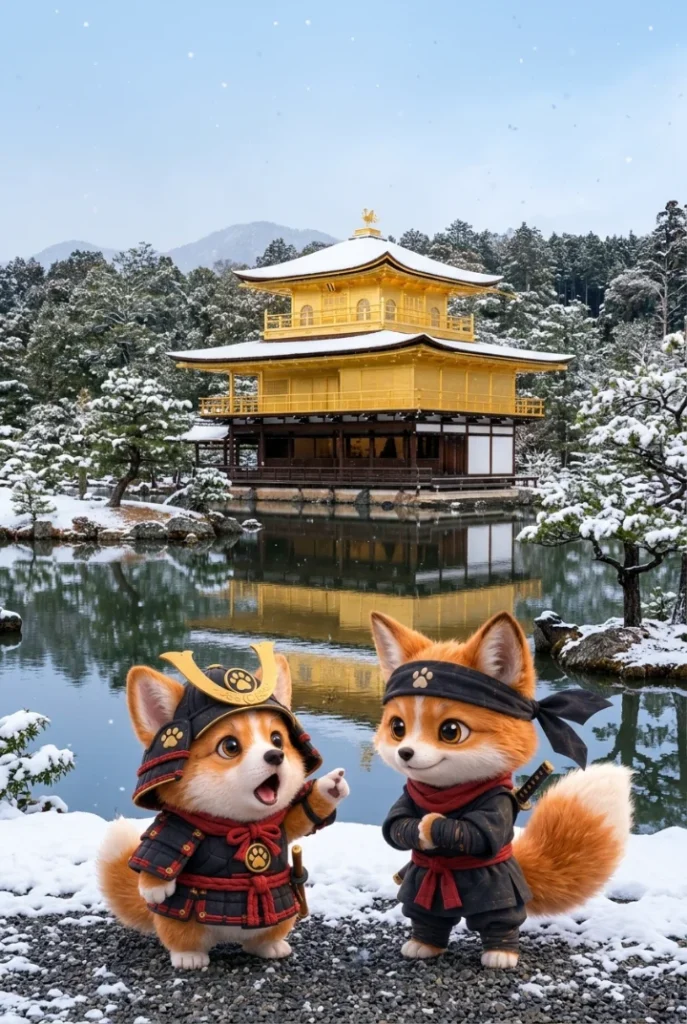
Kojiro the corgi samurai heard a rumor: on a few lucky mornings each winter, the Golden Pavilion wears a white snow hat. Hayate the fox ninja checked the weather, packed hand warmers, and warned him that temple floors in January are colder than the snow outside.
Kyoto in winter is quiet, crisp and (outside New Year) much less crowded than autumn. You get misty temple gardens, steaming bowls of tofu and noodles, year-end markets, the New Year’s Eve temple bells and, if you are lucky, snow on Kinkaku-ji. This guide covers Kyoto’s winter weather month by month, whether it snows, what to wear, things to do in December, January and February 2026–27, what to eat, a 2-day winter itinerary and hotels with hot-spring baths for warming up at night.
Written by Kojiro’s human, who was born and raised in Takayama in the Japanese Alps and now lives in Aichi, a short train ride from Kyoto.
Table of contents
- Is Kyoto worth visiting in winter? Kyoto in winter at a glance
- Kyoto weather in winter: temperature in December, January and February
- Does it snow in Kyoto? How to see Kinkaku-ji in snow
- What to wear in Kyoto in winter
- Things to do in Kyoto in winter
- Kyoto December events 2026: year-end markets and New Year’s Eve bells
- Kyoto in January and February 2027: New Year, special openings, Setsubun and plum blossoms
- What to eat in Kyoto in winter (Kojiro approves!)
- Kyoto in winter itinerary: 2 days
- Where to stay in Kyoto in winter: hotels with hot-spring baths
- Want deep snow? A winter side trip to Takayama and Shirakawago
- Kyoto in winter FAQ
- More Kyoto and winter guides
Quick picks
- Warm up every night (best value): Dormy Inn Premium Kyoto Ekimae, a 3-minute walk from Kyoto Station with a natural hot-spring bath (5.0/5 from 1K+ Klook reviews). Check dates and prices for Dormy Inn Premium Kyoto Ekimae on Klook
- Short on time, want the big sights in one day: a guided day tour to Kinkaku-ji, Kiyomizu-dera, Gion and Fushimi Inari from Kyoto or Osaka (4.7/5 from 1,004 Klook reviews). Check dates for the Kyoto Classic Day Tour on Klook
- Cold or rainy day with kids: head indoors to teamLab Biovortex Kyoto, a short walk from Kyoto Station. Check dates and prices for teamLab Biovortex Kyoto on Klook
Is Kyoto worth visiting in winter? Kyoto in winter at a glance
Yes, especially if you dislike crowds. December to February is Kyoto’s calm season: the autumn crowds are gone, hotels are easier to book (except around New Year), and the gardens look beautiful in frost or light snow. The trade-offs are short days, cold temple floors and a few closures over New Year.
| Best time | Early to mid-December and mid-January to February for the fewest crowds; avoid January 1–3 at big shrines unless you want the New Year buzz |
| Temperature | Daytime highs about 9–12°C (48–53°F), mornings around 1–4°C (35–38°F) (Japan Meteorological Agency 1991–2020 averages) |
| Snow | Flurries are common in January and February, but settled snow in the city is rare and usually melts by noon |
| Time needed | 2–3 days for the main sights; add a day for Nara, Himeji or a snowy side trip |
| Budget | Temple tickets about ¥500–1,000 each; Kinkaku-ji ¥500; Fushimi Inari free. Hotel prices jump around New Year |
| Ease of access | Easy: same trains and buses as the rest of the year; daylight ends around 5 p.m., and many temples close at 4:30–5 p.m. |
Not for you if… you want autumn leaves or cherry blossoms, or you need long days outdoors. In that case, see our Kyoto autumn leaves guide instead. If it’s your first visit, start with our Kyoto itinerary for 2 or 3 days and use this page for the winter tweaks.
Kyoto weather in winter: temperature in December, January and February
Kyoto sits in a basin surrounded by mountains, so winter days feel colder than the numbers suggest: mornings are damp and still, and the cold comes up from the ground. These are the official 30-year averages for Kyoto city.
| Month | Average high | Average low | Rain/snow | What it feels like |
|---|---|---|---|---|
| December | 11.6°C (53°F) | 3.5°C (38°F) | 57 mm | Clear, chilly days; first flurries possible late in the month |
| January | 9.1°C (48°F) | 1.5°C (35°F) | 53 mm | The coldest month; snow falls on about half the days, but rarely settles |
| February | 10.0°C (50°F) | 1.6°C (35°F) | 65 mm | Still cold; the best chance of a real snowfall; plum blossoms start late in the month |
Source: Japan Meteorological Agency, Kyoto station normals 1991–2020. Daylight is short: in December the sun sets before 5 p.m., so plan outdoor sights for the morning and early afternoon.
Does it snow in Kyoto? How to see Kinkaku-ji in snow
Yes, but not much. The Japan Meteorological Agency counts snow falling on about 16 days in January and 14 in February, yet the average total snowfall for the whole year is only about 15 cm (6 inches). Most of the time it is a few flurries that melt on the ground. A few times each winter, a cold night leaves a thin white layer on temple roofs and gardens, and Kyoto turns into a postcard until late morning.
The famous photo is Kinkaku-ji, the Golden Pavilion, with snow on its golden roof. Kinkaku-ji opens every day from 9:00 a.m. to 5:00 p.m., and tickets (¥500 for adults) are sold at the gate, so you don’t need to book. See our Kinkaku-ji guide for the bus from Kyoto Station.
Hayate’s Secret ninja tip: Kinkaku-ji posts an official live camera image on its website, updated every few minutes. If snow is forecast overnight, check the camera at breakfast; if the roof is white, take a taxi and be at the gate at 9:00. The snow usually melts by noon, and everyone else has the same idea.
Other places that look magical in snow: the stone paths of Kiyomizu-dera and Ninenzaka, the Arashiyama bamboo grove, the Fushimi Inari torii gates, and the moss gardens of Ohara and Kurama in the northern hills, which are colder and get snow more often than the city center.
What to wear in Kyoto in winter
- A warm coat (a light down jacket is ideal) plus layers you can take off on heated trains and in shops.
- Thick socks. You take off your shoes in many temple halls, and the old wooden floors are icy. Kyoto’s winter special openings even ask visitors not to go barefoot.
- Shoes that slip on and off easily and have a good grip for wet stone steps.
- Gloves, a scarf or hat, and disposable hand warmers (kairo), sold at every convenience store.
- A small bag for your shoes: some temples ask you to bring one to cut plastic waste.
Things to do in Kyoto in winter
- Temples at opening time: winter mornings are the quietest of the year. Ginkaku-ji switches to winter hours (9:00 a.m. to 4:30 p.m.) from December 1; see our Ginkakuji and Philosopher’s Path guide.
- Fushimi Inari at sunrise: the shrine is free and open 24 hours, so you can walk the torii gates in soft winter light before the crowds. See our Fushimi Inari guide.
- Arashiyama without the crowds: the bamboo grove is calmer in winter, but note the Sagano Romantic Train takes a winter break (a brand-new train debuts on March 1, 2027), so check its operating calendar first. Details in our Arashiyama guide.
- Year-end and New Year events: markets, temple bells and shrine visits (see the next two sections).
- Rare winter-only openings: the Kyoto City “Kyo no Fuyu no Tabi” campaign opens normally closed temple halls and gardens each winter.
- Indoor days: on the coldest or wettest days, Nishiki Market’s covered street, museums, or teamLab Biovortex Kyoto keep you warm.
Want someone else to handle the buses on a short winter day? See the tour comparison in the itinerary section below.
Kyoto December events 2026: year-end markets and New Year’s Eve bells
In Kyoto, the last event of the year at a temple or shrine is called shimai (“the closing one”). The markets are bigger and busier than usual, with New Year goods on sale.
| Date | Event | What happens |
|---|---|---|
| Dec 13 (Sun) | Kotohajime in Gion | Geiko and maiko visit their dance teacher to give year-end thanks, roughly 10:00 a.m. to 3:00 p.m. Watch quietly from the street and give them space. |
| Dec 21 (Mon) | Shimai-Kobo market at Toji Temple | The last monthly flea market of the year, with close to 1,000 stalls; famous for antiques. Go in the morning. |
| Dec 25 (Fri) | Shimai-Tenjin market at Kitano Tenmangu | The year’s last Tenjin market, from about 6 a.m. to 9 p.m. Kinkaku-ji is a short bus or taxi ride away, so combine the two. |
| Dec 27 (Sun), 2:00 p.m. | Chion-in practice bell ringing | 17 monks ring one of Japan’s largest temple bells (about 70 tonnes) as a rehearsal. No registration needed; entry may be limited when crowded. |
| Dec 31 (Thu) | New Year’s Eve bells (joya no kane) | Temples ring their bells 108 times to clear away the year’s worldly desires. See below. |
| Dec 31 (Thu), evening | Okera-mairi at Yasaka Shrine | After the 7:00 p.m. year-end ceremony, a sacred fire burns through the night. Locals light a rope from it and swing it in circles to keep it alight on the way home. |
New Year’s Eve bells in Kyoto: where you can watch, and where you can ring
- Chion-in: the most famous. Starts at 10:20 p.m.; viewing only, by advance registration, ¥3,000 per person (free for elementary-school age and younger). Last year, online applications opened on December 1 on a first-come, first-served basis (a limited number of tickets were also sold at the temple from December 8), so check the temple’s website early.
- Eikando: 11:00 p.m. to 12:30 a.m. If you are in line during that time, you can ring the bell yourself.
- Tenryu-ji (Arashiyama): starts at 11:45 p.m.; numbered tickets are handed out from 11:30 p.m. to the first 108 groups.
- Shinnyo-do: starts at 11:45 p.m.; groups of 4–5 people ring together, with free herbal tea while it lasts.
Hayate’s Secret ninja tip: New Year’s Eve in Kyoto is cold, dark and busy. Wear your warmest layers, use the restroom before you join a line, and check the special New Year’s Eve schedules for trains and buses before you go, so you are not stuck after midnight. Times above are from Kyoto City’s official 2026 list.
Kyoto in January and February 2027: New Year, special openings, Setsubun and plum blossoms
January 1–3: New Year (Shogatsu)
New Year is Japan’s biggest family holiday. Locals make their first shrine visit of the year (hatsumode), so Fushimi Inari and Yasaka Shrine are packed from midnight on January 1 through January 3. It’s a fun, festive atmosphere with food stalls, but go early in the morning if you want room to move.
- Many shops and restaurants close on January 1–3; many Nishiki Market shops close too. Big-chain restaurants, convenience stores and hotel restaurants stay open.
- Kinkaku-ji is open every day of the year. At Nijo Castle, the grounds close December 29–31 and the Ninomaru Palace is closed December 26–28 and January 1–3 (also on the third Monday of each month and the following day, e.g. January 18–19 and February 15–16, 2027). See our Nijo Castle guide.
- Hotels are most expensive and fill first around December 29 to January 3. If your dates fall then, book your room now.
January to March: Kyo no Fuyu no Tabi (winter special openings)
Every winter, Kyoto City and its tourism association open temple halls, gardens and paintings that are normally closed to the public. In 2026 it ran from January 9 to March 18, 10:00 a.m. to 4:30 p.m., at ¥800 per site, and individual visitors did not need a reservation at most sites. As of mid-November 2026, the 2027 program had not been announced yet; it is published on the official Kyoto City tourism site.
Around February 3: Setsubun
Setsubun, on February 3 in 2027, marks the day before the start of spring on the old calendar. Shrines and temples chase away demons with roasted soybeans. Yoshida Shrine is famous for its demon-chasing ceremony and food stalls, and at Rozan-ji demons in red, blue and black dance before being driven out. It is free to watch and very local.
February: plum blossoms at Kitano Tenmangu
Kitano Tenmangu has around 1,500 plum trees of about 50 varieties. On February 25, the Baikasai plum festival includes an outdoor tea ceremony served by the geiko and maiko of Kamishichiken, from 10:00 a.m. to 3:00 p.m. (the tea ticket has been ¥3,000 in recent years; check the shrine’s website for 2027).
Crowd note: Lunar New Year falls on February 6, 2027, so expect more visitors from East Asia for about a week around that date.
What to eat in Kyoto in winter (Kojiro approves!)
- Yudofu: silky tofu simmered in kombu broth, dipped in soy sauce with green onion. Kyoto is famous for its tofu, and restaurants around Nanzen-ji and Arashiyama specialize in it. It’s light, warming and vegetarian-friendly (ask whether the dipping sauce uses fish stock).
- Nishin soba: hot buckwheat noodles topped with a sweet simmered herring, a Kyoto classic for a cold afternoon.
- Amazake: a warm, sweet rice drink sold at shrines and teahouses in winter. Most amazake made from rice malt is alcohol-free; the kind made from sake lees has a little alcohol, so ask if you need to avoid it.
- Shiro-miso ozoni: Kyoto’s New Year soup uses white miso and round rice cakes, unlike the clear soup of Tokyo. You’ll find it on New Year menus at ryokan and some restaurants.
Kojiro approves! A steaming pot of yudofu after a cold morning at the temples. Simple, light and warming: on a frosty Kyoto day it feels like a hug in a bowl.
For snacks and souvenirs on a rainy day, Kyoto’s covered food street is perfect: see our Nishiki Market guide (remember, many shops close January 1–3).
Kyoto in winter itinerary: 2 days
This plan puts outdoor sights in the morning, when light is best and crowds are smallest, and saves warm, indoor or evening stops for later.
Day 1: Golden Pavilion, Arashiyama and a hot bath
- 9:00 Kinkaku-ji at opening (check the live camera if snow was forecast).
- 10:30 Bus or taxi to Arashiyama: the bamboo grove and Tenryu-ji garden.
- 12:30 Yudofu lunch in Arashiyama.
- 14:30 Back toward the center; Nishiki Market for snacks before shops close around 6 p.m.
- Evening Back to your hotel’s hot-spring bath.
Day 2: Fushimi Inari, Higashiyama and Gion
- 7:30 Fushimi Inari’s torii gates in the quiet morning (5 minutes by JR from Kyoto Station).
- 10:30 Kiyomizu-dera and the stone lanes of Ninenzaka and Sannenzaka.
- 13:00 Nishin soba or amazake break.
- 15:00 Yasaka Shrine and Gion at dusk, when the lanterns come on (see our Gion guide).
Kyoto winter tour: worth it?
You don’t need a tour in winter: buses run as usual and temple tickets are sold at the gate. A tour makes sense if you have only one day, are coming from Osaka, or don’t want to wait for buses in the cold.
| Route | Kinkaku-ji, Kiyomizu-dera, Ninenzaka, Gion and Hanamikoji, Yasaka Shrine and Fushimi Inari |
| Best for | First-timers with one day who want the classic sights without planning buses |
| Not for | Travelers who like slow, long visits or want to catch Kinkaku-ji the moment it snows |
| Departs from | Osaka or Kyoto |
| Guide | Chinese, English and Japanese |
| Rating | 4.7 out of 5 from 1,004 reviews on Klook (checked November 2026) |
| Cancellation | Check the terms on the booking page before you book |
| Our verdict | An easy way to see the headline sights on a short winter day |
What travelers say: reviewers on Klook (including winter dates in December, January and February) most often praise friendly, attentive guides who switch between Chinese and English, a smooth schedule with enough free time at each stop, and help with small things like finding an ATM. The main caution they mention is that the big sights are crowded, and that everyone needs to be on time at the meeting points.
Check dates and prices for the Kyoto Classic Day Tour on Klook
Where to stay in Kyoto in winter: hotels with hot-spring baths
After a cold day of temples, a big hot bath makes all the difference. Kyoto isn’t an onsen town, but these city hotels near the station and downtown have hot-spring baths. Shared baths are separated by gender, and you bathe without a swimsuit.
| Hotel | Area | Why it’s good in winter | Klook rating (Nov 2026) |
|---|---|---|---|
| Dormy Inn Premium Kyoto Ekimae | Kyoto Station (3-minute walk) | Natural hot-spring bath; free late-night ramen | 5.0/5, 1K+ reviews |
| Onyado Nono Kyoto Shichijo | Walking distance to Kyoto Station | Tatami floors throughout; natural hot-spring bath open all night | 4.8/5, 4K+ reviews |
| Sora Niwa Terrace Kyoto | Kawaramachi (3-minute walk), near Gion | Hot-spring bath with city views; rooftop foot baths | 4.9/5, 421 reviews |
- Best for a station base: Check dates and prices for Dormy Inn Premium Kyoto Ekimae on Klook
- Best ryokan feel at a hotel price: Check dates and prices for Onyado Nono Kyoto Shichijo on Klook
- Best for Gion and nightlife: Check dates and prices for Sora Niwa Terrace Kyoto on Klook
Book now if your trip includes December 29 to January 3, when Japanese families travel and prices climb. For more areas and budgets, see Where to Stay in Kyoto, or browse all Kyoto hotels on Klook.
Want deep snow? A winter side trip to Takayama and Shirakawago
Kyoto’s snow is gentle and rare. If you dream of deep snow on thatched roofs, go to the mountains. Takayama, my hometown, and the gassho-zukuri village of Shirakawa-go (Shirakawago) are real snow country, and a direct highway bus from Kyoto to Takayama costs ¥6,500 one way (see How to Get to Takayama).
Kojiro’s human says: Winter in Takayama is seriously cold – a down jacket is a must! And watch out for icy streets so you don’t slip and fall.
- Takayama in Winter: weather, what to wear and things to do
- Shirakawago Light-Up 2027: January 11, 17, 24 and 31, reservation only
Kyoto in winter FAQ
Is Kyoto worth visiting in winter?
Yes. Outside New Year, winter is Kyoto’s quietest season, with crisp air, calm temples and easier hotel bookings. Just plan for short days and cold indoor floors.
Does it snow in Kyoto in December?
Rarely. Snow falls on about 7 days in an average December, but it seldom settles in the city. January and February are your best chances.
How cold is Kyoto in January?
The average high is 9.1°C (48°F) and the average low 1.5°C (35°F). It feels colder in the morning and inside old wooden halls.
Is Kyoto crowded in winter?
Mostly no. The exceptions are January 1–3 at big shrines like Fushimi Inari and Yasaka, New Year’s Eve at famous temples, and the week around Lunar New Year (February 6, 2027).
Are temples open on New Year’s Day in Kyoto?
Most temples and shrines are open, and Kinkaku-ji is open every day of the year. Some sites close for a few days around New Year, such as the Ninomaru Palace at Nijo Castle (closed January 1–3, and again January 18–19), so check before you go.
What should I wear in Kyoto in winter?
A warm coat, layers, thick socks for temple floors, slip-on shoes with a good grip, gloves and a hat. Disposable hand warmers from convenience stores help a lot.
What can I do in Kyoto in winter with kids?
Morning walks at Fushimi Inari, feeding the deer on a day trip to Nara, and indoor stops like teamLab Biovortex Kyoto or the Kyoto Aquarium. Check Kyoto Aquarium tickets on Klook.
Before you go: covering Tokyo, Kyoto and Hiroshima by shinkansen? Check JR Pass prices on Klook. Need data for maps and bus times? Get an Airalo Japan eSIM.
More Kyoto and winter guides
- Kyoto itinerary for 2 or 3 days: the classic first-timer plan
- Kinkaku-ji guide: tickets, bus and the best time for photos
- Fushimi Inari guide: the torii gates before the crowds
- Where to stay in Kyoto: the best areas and hotels
- Kyoto to Nara day trip: an easy half-day escape
- Takayama in winter: real snow in the Japanese Alps
- Kurama to Kibune hike: a forest temple, the lantern steps of Kifune Shrine and the Eizan Railway
- Amanohashidate and Ine Funaya day trip: snowy pines, crab season and the winter closures
Last checked on official sites: November 2026. Event dates, hours and prices can change, so check before you go.
This post contains affiliate links. If you book through them, we may earn a small commission at no extra cost to you. Food tips are honest recommendations with no affiliate links.
Kojiro and Hayate are AI-generated characters; all character images are AI-generated illustrations.
Sources: Japan Meteorological Agency: Kyoto climate normals · Kyoto City: 2026 New Year’s Eve bells list (Japanese) · Kyoto City: December year-end events (Japanese) · Kyoto City: Okera-mairi at Yasaka Shrine (Japanese) · Chion-in: New Year’s Eve bell (official) · Kyo no Fuyu no Tabi winter special openings (official, Japanese) · Kyoto City: Setsubun (Japanese) · Kitano Tenmangu Baikasai (Rurubu, Japanese) · Sagano Scenic Railway (official) · Kinkaku-ji: access and hours (official)