Kojiro heard there was a street in Kyoto where the whole city buys its dinner, and he has not stopped thinking about it since. Hayate agreed to come on one condition: they follow the market’s manners and eat every bite standing politely in front of the shop. Kojiro said that was “the easiest rule ever.” (It was not.)
Nishiki Market is a narrow covered shopping street in central Kyoto, about 390 meters long, lined with about 130 small shops selling fish, pickles, tofu, sweets, tea, knives and ready-to-eat snacks. Locals call it “Kyoto’s kitchen.” Here are the hours, the closed days, what to eat, the eating rules, how to get there and an easy half-day plan with Gion.

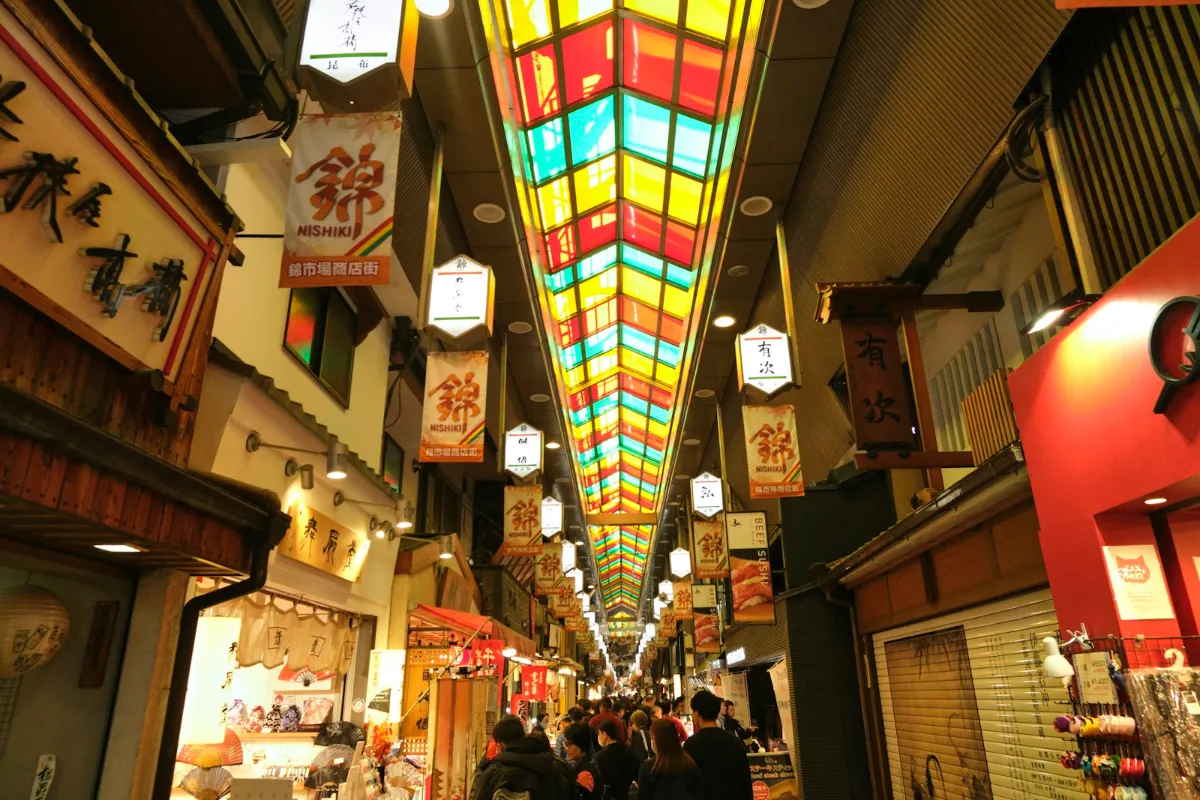
Table of contents
- Nishiki Market at a glance: hours, cost and time needed
- How to get to Nishiki Market from Kyoto Station (and Osaka, Tokyo)
- Nishiki Market hours and closed days
- Can you eat while walking in Nishiki Market? The rules
- What to eat at Nishiki Market (Kojiro approves!)
- What to buy in Nishiki Market: souvenirs, knives and furikake
- Nishiki Tenmangu Shrine at the end of the market
- Nishiki Market best time to go (and is it a tourist trap?)
- Nishiki Market food tours and what travelers say
- Nishiki Market and Gion: an easy half-day plan
- Where to stay near Nishiki Market
- Nishiki Market FAQ
- More Kyoto guides
Quick picks
- Visiting on your own: Nishiki Market is free to walk and you don’t need a tour. Come in the late morning when most stalls are open.
- Taste with a local: a 2-hour food tour of Nishiki and a department-store food hall (4.7/5 from 16 Klook reviews). Check dates and prices for the Nishiki Market & Depachika Food Tour on Klook
- Stay a few minutes away: Check dates and prices for Hotel M’s Est Shijo Karasuma on Klook (4.8/5 from 1,032 Klook reviews)
Nishiki Market at a glance: hours, cost and time needed
| Admission | Free; you pay only for what you buy |
| Size | About 390 m long and 3.3 to 5 m wide, between Teramachi and Takakura streets; the market association lists around 130 shops |
| Hours | Set by each shop; typically about 10:00 a.m. to 6:00 p.m., a few open earlier |
| Closed | No market-wide closing day; many shops close on Wednesdays, and many close January 1 to 3 |
| Time needed | 1 to 2 hours to walk, snack and shop |
| Snack budget | About ¥2,000 to ¥4,000 per person for a good tasting walk (our estimate) |
| Best time | Weekday late morning, about 10:00 to 11:30 a.m. |
| Ease of access | Very easy: 3 to 4 minutes on foot from Shijo, Karasuma or Kyoto-Kawaramachi stations |
Secret ninja tip: Nishiki is a working market for locals, not a theme park. Keep to the left in the narrow aisle, step aside to look at your phone, and you will be welcomed everywhere.
Free printable: Kyoto Trip Checklist. What to book ahead, what to pack, Gion and Nishiki manners, three phrases and a 3-day planner on two pages. Enter your email and the download link arrives in your welcome email (see what’s inside).
How to get to Nishiki Market from Kyoto Station (and Osaka, Tokyo)
| From | Route | Time (approx.) | Cost (approx.) |
|---|---|---|---|
| Kyoto Station (easiest) | Karasuma subway line to Shijo Station, then walk about 3 minutes | About 4 minutes on the train | About ¥220 |
| Kyoto Station (bus) | City Bus No. 5 to Shijo Takakura (in front of Daimaru), then walk about 2 minutes | About 20 minutes, longer in traffic | City bus flat fare |
| Gion / Kawaramachi | Walk west along Shijo-dori; the Teramachi end of the market is a short walk from Kyoto-Kawaramachi Station (Hankyu) | About 10 minutes on foot from Gion-Shijo | Free |
| Osaka | Hankyu Kyoto Line limited express from Osaka-Umeda to Kyoto-Kawaramachi or Karasuma, then walk about 4 minutes | About 45 minutes | About ¥410 |
| Tokyo | Tokaido Shinkansen to Kyoto Station, then the Karasuma subway line to Shijo | About 2 hours 15 minutes by Nozomi, plus about 10 minutes | About ¥14,000 one way for a reserved seat |
Times and fares are approximate and can change, so check a route app before you go. Tap in with an IC card (Suica, PASMO or ICOCA) on the subway and buses. The market is an easy place to get lost in side streets, so keep Google Maps working with a Airalo Japan eSIM. Coming from Tokyo? Compare JR Passes and Shinkansen tickets on Klook.
Open Nishiki Market in Google Maps
Nishiki Market hours and closed days
There is no single opening time: each shop sets its own hours and days off. As a rule of thumb, most shops are open from about 10:00 a.m. to 6:00 p.m. Some, like the omelet and deli shop Nishiki Hirano, start around 8:30 a.m., while others close at 5:00 p.m. or sell out earlier.
- Wednesday: the official market association says many shops close on Wednesdays. The street is still open, but expect a lot of shutters
- Sunday: most food shops are open, and it is one of the busiest days
- New Year: most shops stay open at year-end, but many close January 1 to 3
- Evening: by 6:00 p.m. most shops are closing. “Nishiki Market at night” is quiet; go to nearby Pontocho for dinner instead
- Restrooms: the market association office has a restroom (10:00 a.m. to 5:00 p.m.), and the official map shows public toilets nearby
Can you eat while walking in Nishiki Market? The rules
No, please do not eat while walking. The Nishiki Market association asks visitors not to walk through the market while eating, because the aisle is narrow and food can stain other shoppers’ clothes. Instead, eat your food in front of the shop where you bought it, or inside if it has seating.
- Buy, step to the side of that shop, eat, and return the stick or cup to the shop
- Do not carry food from one shop to eat in front of another
- Bins are rare on the street, so keep a small bag for your own trash
- Ask before taking close-up photos of a shop or its staff, and do not block the aisle for photos
- Many small shops prefer cash; card and IC payment depend on the shop

Kojiro started to waddle off with his first snack. A gentle tail pulled him back to the shop counter. “Eat here,” whispered Hayate. Kojiro discovered that standing still also means more time to smell the next stall.
What to eat at Nishiki Market (Kojiro approves!)
Nishiki is best as a tasting walk: lots of small bites instead of one big meal. Here is what we would look for:
- Dashimaki tamago: a soft, juicy rolled omelet made with dashi broth, a Kyoto classic. Nishiki Hirano is known for it, along with a tempura and omelet set in its small dining space
- Soy milk doughnuts and tofu sweets: Konnamonja, a tofu shop, sells warm little soy milk doughnuts and soy milk soft-serve
- Yuba (tofu skin): a delicate Kyoto specialty, served fresh or in small dishes
- Grilled skewers: seafood, tamagoyaki and seasonal vegetables on a stick; look for small octopus skewers with a quail egg inside
- Tsukemono (Kyoto pickles): many shops offer free tastings of seasonal pickles. A tip from our Takayama-born writer, who grew up around morning markets: taste one or two, say “oishii” (delicious), and buy a small pack if you liked it; shopkeepers love it when you ask which pickle is in season
- Matcha and wagashi: green tea sweets, soft-serve and Japanese confectionery. Hayate tries to stay cool, but he always buys one
- Fresh seafood and oysters: some fish shops sell sashimi or grilled fish to eat on the spot
- Sit-down lunch: a few small restaurants serve rice bowls, gyoza and set meals if you want to sit down
Kojiro approves! Share bites with friends so you can try more. Prices on sticks and small cups are usually a few hundred yen each.
What to buy in Nishiki Market: souvenirs, knives and furikake
- Kitchen knives: Aritsugu, founded in 1560 by a family of swordsmiths, sells handmade knives and cooking tools (about 10:00 a.m. to 4:00 p.m., closed Wednesdays and for three days from January 1). Ask in the shop about name engraving
- Furikake and dried foods: spicy furikake (rice seasoning), sansho pepper, dried fish and kelp are light, easy souvenirs
- Tea: sencha, hojicha and matcha from specialist tea shops
- Kyoto pickles: many are vacuum-packed for travel; check customs rules for your home country
- Chopsticks and kitchen goods: small, light and useful
Want even more shopping? The east end of Nishiki meets the covered Teramachi and Shinkyogoku shopping arcades, full of souvenir, clothing and stationery shops.
Nishiki Tenmangu Shrine at the end of the market
At the east end of the market, Nishiki Tenmangu is a small shrine to Tenjin, the god of learning. It is free and open every day from about 8:00 a.m. to 8:00 p.m. Look for the mechanical lion that dances and brings you a paper fortune (English ones are available) for a ¥200 coin, the stone cow that visitors rub for luck, and the spring water that has given the area its name: Nishiki’s cold groundwater is the reason a food market grew up here centuries ago.

A little history: official records date the market to 1615, when the shogunate approved fish wholesalers here, and the cold well water (about 15 to 18°C all year) was used to keep fish and vegetables fresh.
Nishiki Market best time to go (and is it a tourist trap?)
- Best: weekdays (not Wednesday) from about 10:00 to 11:30 a.m., when shops are open and before the lunch rush
- Busiest: around noon to 3:00 p.m., weekends, holidays and the autumn leaf season
- Late afternoon: quieter, but some shops close around 5:00 p.m. or sell out
- Rainy days: the street is covered, so it is a great rainy-day plan
Is Nishiki Market a tourist trap? Some travelers feel that way when it is packed and prices on snacks are higher than in a supermarket. It is still a real market where Kyoto restaurants and families buy pickles, fish and tofu, with shops that have been here for generations. Go early, buy from the specialist shops and sample local foods, and it is well worth an hour or two.
Nishiki Market vs. Kuromon Market: Osaka’s Kuromon Market is bigger on grilled seafood and wagyu skewers. Nishiki is narrower and more focused on Kyoto’s traditional foods: pickles, tofu, yuba, tea and sweets.
Nishiki Market food tours and what travelers say
You can walk Nishiki on your own, but a local guide explains what you are tasting and takes you to shops you would walk past. Two options on Klook, with what reviewers say most often:
Nishiki Market and depachika food tour
Kyoto Nishiki Market & Depachika: 2-hours Food Tour with a Local: rated 4.7 by 16 reviewers, about 2 hours, ending at Nishiki Tenmangu.
- Reviewers praise friendly, knowledgeable guides and say the pace is relaxed, not rushed
- Many liked trying foods they would not have picked alone, such as tofu skin
- Guides were flexible about skipping or adding foods; one reviewer felt a few items were just okay
| Best for | Food lovers who want the stories behind what they taste, at a relaxed pace |
| Not for | Travelers on a tight budget: you can graze Nishiki on your own |
| Duration | About 2 hours, ending at Nishiki Tenmangu |
| Guide | English |
| Price | From about US$55 per person on Klook when we checked |
| Rating | 4.7 out of 5 from 16 reviews on Klook (checked October 2026) |
| Cancellation | Check the terms on the booking page before you book |
Check dates and prices for the Nishiki Market & Depachika Food Tour on Klook
Half-day morning walking food tour with Gion
Nishiki Market Half Day Morning Walking Food Tour in Kyoto: rated 4.7 by 18 reviewers, about 3 hours, including a walk through Gion.
- Reviewers mention enthusiastic guides with good stories about food culture and history
- The food samples and the walking pace get frequent praise
- Note: the listing says vegan and gluten-free requests cannot be accommodated
| Best for | Morning visitors who want Nishiki plus a guided walk through Gion |
| Not for | Vegan or gluten-free diets (the listing says these cannot be accommodated) |
| Duration | About 3 hours |
| Guide | English or Japanese |
| Price | From about US$83 per person on Klook when we checked |
| Rating | 4.7 out of 5 from 18 reviews on Klook (checked October 2026) |
| Cancellation | Check the terms on the booking page before you book |
Check dates and prices for the Nishiki Market Half-Day Morning Food Tour on Klook
Ratings and review themes as shown on Klook in October 2026. Review counts are still small, so check the latest reviews before booking.
Nishiki Market and Gion: an easy half-day plan
- 10:00 Enter from the Takakura (west) end and walk east, snacking as you go
- 11:30 Nishiki Tenmangu Shrine and a fortune from the mechanical lion
- 12:00 Sit-down lunch nearby, or keep snacking
- 13:00 Walk east along Shijo-dori across the Kamo River to Gion (about 10 to 15 minutes)
- 13:30 Hanamikoji Street, Yasaka Shrine and the lanes of Higashiyama
- 15:00 Continue uphill to Kiyomizu-dera (roughly 20 to 30 minutes uphill on foot from Yasaka Shrine)
Kojiro waddled the whole way. Hayate was already waiting at every corner in a puff of smoke, holding the next snack.
Where to stay near Nishiki Market
The area around Nishiki, between Karasuma and Kawaramachi, is one of the most convenient bases in Kyoto: two subway and train lines, Gion on foot, and plenty of restaurants open in the evening.
- Budget pick: Hotel M’s Est Shijo Karasuma, about 2 minutes on foot from Karasuma Station, with simple, compact rooms (4.8/5 from 1,032 Klook reviews). Check dates and prices for Hotel M’s Est Shijo Karasuma on Klook
- Mid-range pick: Candeo Hotels Kyoto Karasuma Rokkaku, with a shared bath and sauna (4.5/5 from 359 Klook reviews). Check dates and prices for Candeo Hotels Kyoto Karasuma Rokkaku on Klook
- Areas, budgets and our hotel picks: Where to Stay in Kyoto: Kojiro & Hayate’s Hotel Picks
- Browse Kyoto hotels on Klook (search for Shijo or Kawaramachi on the map)
Nishiki Market FAQ
What time does Nishiki Market open and close?
Each shop sets its own hours, but most are open from about 10:00 a.m. to 6:00 p.m. A few open around 8:30 to 9:00 a.m., and many close earlier or when sold out.
Is Nishiki Market closed on Wednesday?
The street itself is open, but many shops take Wednesday as their day off, so it is the weakest day to visit. Most shops are open on Sundays.
Is Nishiki Market worth it?
Yes, for food lovers and first-time visitors, especially on a weekday morning. Allow one to two hours and come hungry.
Do Nishiki Market shops take credit cards?
It depends on the shop. Bring cash in small bills and coins for snacks; larger shops are more likely to take cards or IC cards.
Is Nishiki Market open at night?
Not really. Most shops close by 6:00 p.m. For dinner, head to Pontocho Alley or Gion, both a short walk away. Planning more of Kyoto? See our Fushimi Inari guide for a sunrise visit and our Arashiyama guide for a full day out west.
Trip prep checklist
- Japan eSIM (Airalo) and an IC card
- Cash in coins and small bills
- A small bag for your own trash
- Come hungry, and plan to eat in front of each shop
- Everything we recommend in one place: Japan Travel Kit
More Kyoto guides
- Kiyomizu-dera guide: the temple on stilts and the 2026 night illumination
- Fushimi Inari guide: 10,000 torii gates and kitsune udon
- Arashiyama guide: Bamboo Grove tips, Sagano train and a one-day itinerary
- Kinkaku-ji guide: the Golden Pavilion
- Ginkakuji and the Philosopher’s Path guide
- Nijo Castle guide
- Where to stay in Kyoto: the best areas and hotels
- Kyoto itinerary for 2 or 3 days: a day-by-day plan with a map
- Samurai & Ninja Museum Kyoto: is it worth it, tickets and what you do
- Kyoto in winter: New Year closures, events and warming winter food

Official sites: Nishiki Market (Kyoto Nishiki Market Promotion Association), Kyoto City Official Travel Guide.
Last checked on official sites: October 2026. Shop hours, prices and fares can change, so check before you go.
This post contains affiliate links. If you book through them, we may earn a small commission at no extra cost to you.
Kojiro and Hayate are AI-generated characters; all character images are AI-generated illustrations.
Sources: Nishiki Market: access and visitor requests · Nishiki Market: history · Nishiki Market: FAQ · Aritsugu · Nishiki Hirano · Konnamonja · Kyoto City Official Travel Guide: Nishiki Market · japan-guide.com: Nishiki Market · Discover Kyoto: Nishiki Tenmangu · GLTJP: Osaka to Kyoto by train · Klook activity pages (linked above)